


Gifting Made Simple
Give the Gift of ChoiceClick below to purchase a Prairie Mall eGift Card that can be used at participating retailers at Prairie Mall.Buy Gift CardHome
Revolution by Judiciary by Jed Rubenfeld, Hardcover | Indigo Chapters
Coles
Loading Inventory...
Revolution by Judiciary by Jed Rubenfeld, Hardcover | Indigo Chapters
By Jed Rubenfeld
Current price: $99.00
Coles
Revolution by Judiciary by Jed Rubenfeld, Hardcover | Indigo Chapters
By Jed Rubenfeld
Current price: $99.00
Loading Inventory...
Size: 1 x 1 x 1.25
*Product information may vary - to confirm product availability, pricing, shipping and return information please contact Coles
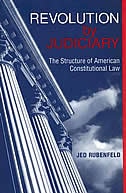
Although constitutional law is supposed to be fixed and enduring, its central narrative in the twentieth century has been one of radical reinterpretation-Brown v. Board of Education, Roe v. Wade, Bush v. Gore. What, if anything, justifies such radical reinterpretation? How does it work doctrinally? What, if anything, structures it or limits it? Jed Rubenfeld finds a pattern in American constitutional interpretation that answers these questions convincingly. He posits two different understandings of how constitutional rights would apply or not apply to particular legislation. One is that a right would be violated if certain laws were passed. The other is that a right would not be violated. He calls the former Application Understandings and the latter No-Application Understandings. He finds that constitutional law has almost always adhered to all of the original Application Understandings, but where it has departed from history, as it did in the Brown decision, it has departed from No-Application Understandings. Specifically, the Fourteenth Amendment did not prohibit racial segregation, so Rubenfeld argues that the Supreme Court had no problem reinterpreting it to prohibit it. It was a No-Application Understanding. This is a powerful argument that challenges current theories of constitutional interpretation from Bork to Dworkin. It rejects simplistic originalism, but restores historicity to constitutional theorizing. | Revolution by Judiciary by Jed Rubenfeld, Hardcover | Indigo Chapters
Although constitutional law is supposed to be fixed and enduring, its central narrative in the twentieth century has been one of radical reinterpretation-Brown v. Board of Education, Roe v. Wade, Bush v. Gore. What, if anything, justifies such radical reinterpretation? How does it work doctrinally? What, if anything, structures it or limits it? Jed Rubenfeld finds a pattern in American constitutional interpretation that answers these questions convincingly. He posits two different understandings of how constitutional rights would apply or not apply to particular legislation. One is that a right would be violated if certain laws were passed. The other is that a right would not be violated. He calls the former Application Understandings and the latter No-Application Understandings. He finds that constitutional law has almost always adhered to all of the original Application Understandings, but where it has departed from history, as it did in the Brown decision, it has departed from No-Application Understandings. Specifically, the Fourteenth Amendment did not prohibit racial segregation, so Rubenfeld argues that the Supreme Court had no problem reinterpreting it to prohibit it. It was a No-Application Understanding. This is a powerful argument that challenges current theories of constitutional interpretation from Bork to Dworkin. It rejects simplistic originalism, but restores historicity to constitutional theorizing. | Revolution by Judiciary by Jed Rubenfeld, Hardcover | Indigo Chapters
You May Also Like












More About Coles at Prairie Mall
11801 100 St #104, Grande Prairie, AB T8V 3Y2, Canada
Find Coles at Prairie Mall in Grande Prairie, AB
Visit Coles at Prairie Mall in Grande Prairie, AB