


Gifting Made Simple
Give the Gift of ChoiceClick below to purchase a Prairie Mall eGift Card that can be used at participating retailers at Prairie Mall.Buy Gift CardHome
Quantum Field Theory for Economics and Finance
Coles
Loading Inventory...
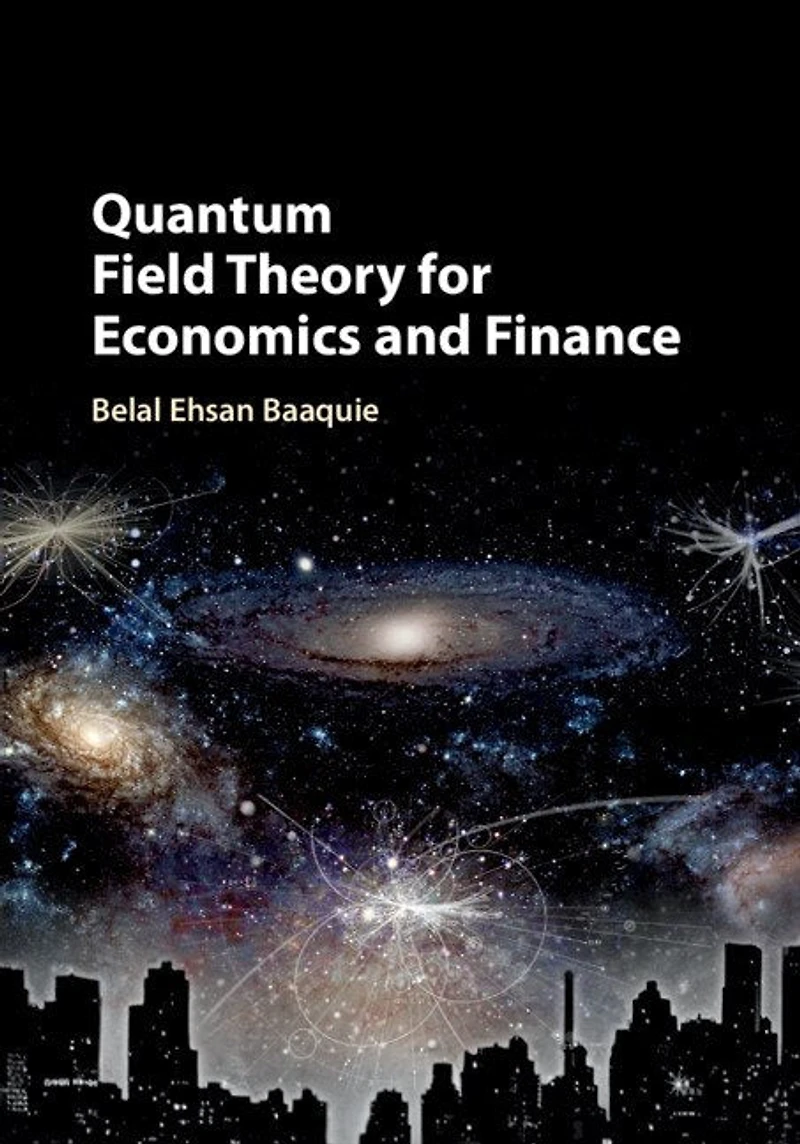
Quantum Field Theory for Economics and Finance in Grande Prairie, AB
Current price: $283.95
Coles
Quantum Field Theory for Economics and Finance in Grande Prairie, AB
Current price: $283.95
Loading Inventory...
Size: Hardcover
*Product information and pricing may vary - to confirm current pricing, availability, shipping, and return information please contact Coles. In the event of a pricing discrepancy, the retailer's price will apply.
An introduction to how the mathematical tools from quantum field theory can be applied to economics and finance, providing a wide range of quantum mathematical techniques for designing financial instruments. The ideas of Lagrangians, Hamiltonians, state spaces, operators and Feynman path integrals are demonstrated to be the mathematical underpinning of quantum field theory, and which are employed to formulate a comprehensive mathematical theory of asset pricing as well as of interest rates, which are validated by empirical evidence. Numerical algorithms and simulations are applied to the study of asset pricing models as well as of nonlinear interest rates. A range of economic and financial topics are shown to have quantum mechanical formulations, including options, coupon bonds, nonlinear interest rates, risky bonds and the microeconomic action functional. This is an invaluable resource for experts in quantitative finance and in mathematics who have no specialist knowledge of quantum field theory.
An introduction to how the mathematical tools from quantum field theory can be applied to economics and finance, providing a wide range of quantum mathematical techniques for designing financial instruments. The ideas of Lagrangians, Hamiltonians, state spaces, operators and Feynman path integrals are demonstrated to be the mathematical underpinning of quantum field theory, and which are employed to formulate a comprehensive mathematical theory of asset pricing as well as of interest rates, which are validated by empirical evidence. Numerical algorithms and simulations are applied to the study of asset pricing models as well as of nonlinear interest rates. A range of economic and financial topics are shown to have quantum mechanical formulations, including options, coupon bonds, nonlinear interest rates, risky bonds and the microeconomic action functional. This is an invaluable resource for experts in quantitative finance and in mathematics who have no specialist knowledge of quantum field theory.
You May Also Like










Find at Prairie Mall in Grande Prairie, AB
Visit at Prairie Mall in Grande Prairie, AB