


Gifting Made Simple
Give the Gift of ChoiceClick below to purchase a Prairie Mall eGift Card that can be used at participating retailers at Prairie Mall.Buy Gift CardHome
Numerical Calculation for Physics Laboratory Projects Using Microsoft EXCEL(R)
Coles
Loading Inventory...
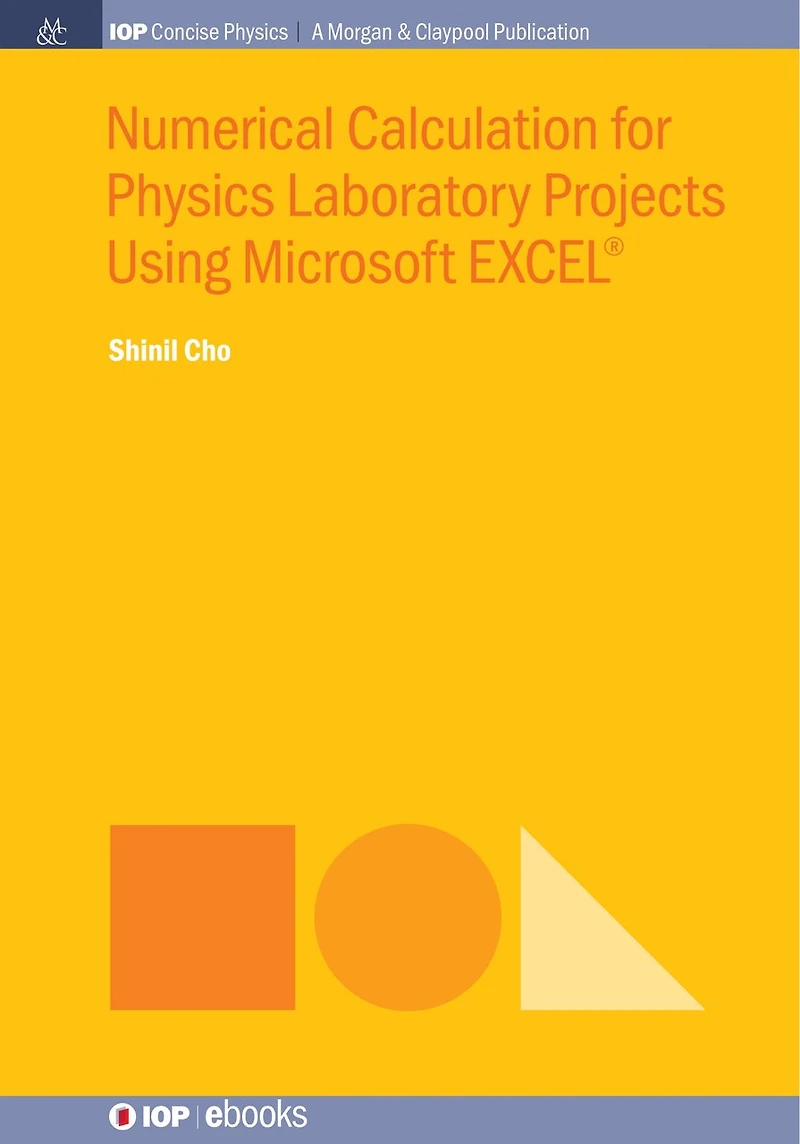
Numerical Calculation for Physics Laboratory Projects Using Microsoft EXCEL(R) in Grande Prairie, AB
Current price: $110.95
Coles
Numerical Calculation for Physics Laboratory Projects Using Microsoft EXCEL(R) in Grande Prairie, AB
Current price: $110.95
Loading Inventory...
Size: Hardcover
*Product information and pricing may vary - to confirm current pricing, availability, shipping, and return information please contact Coles. In the event of a pricing discrepancy, the retailer's price will apply.
This book covers essential Microsoft EXCEL(R)'s computational skills while analyzing introductory physics projects. Topics of numerical analysis include; multiple graphs on the same sheet, calculation of descriptive statistical parameters, a 3-point interpolation, the Euler and the Runge-Kutter methods to solve equations of motion, the Fourier transform to calculate the normal modes of a double pendulum, matrix calculations to solve coupled linear equations of a DC circuit, animation of waves and Lissajous figures, electric and magnetic field calculations from the Poisson equation and its 3D surface graphs, variational calculus such as Fermat's least traveling time principle and the least action principle. Nelson's stochastic quantum dynamics is also introduced to draw quantum particle trajectories.
This book covers essential Microsoft EXCEL(R)'s computational skills while analyzing introductory physics projects. Topics of numerical analysis include; multiple graphs on the same sheet, calculation of descriptive statistical parameters, a 3-point interpolation, the Euler and the Runge-Kutter methods to solve equations of motion, the Fourier transform to calculate the normal modes of a double pendulum, matrix calculations to solve coupled linear equations of a DC circuit, animation of waves and Lissajous figures, electric and magnetic field calculations from the Poisson equation and its 3D surface graphs, variational calculus such as Fermat's least traveling time principle and the least action principle. Nelson's stochastic quantum dynamics is also introduced to draw quantum particle trajectories.
You May Also Like















Find at Prairie Mall in Grande Prairie, AB
Visit at Prairie Mall in Grande Prairie, AB