


Gifting Made Simple
Give the Gift of ChoiceClick below to purchase a Prairie Mall eGift Card that can be used at participating retailers at Prairie Mall.Buy Gift CardHome
Moving to Think: The Neurobiology of the Kinesthetic Classroom and Why Children Must Move to Learn Math
Coles
Loading Inventory...
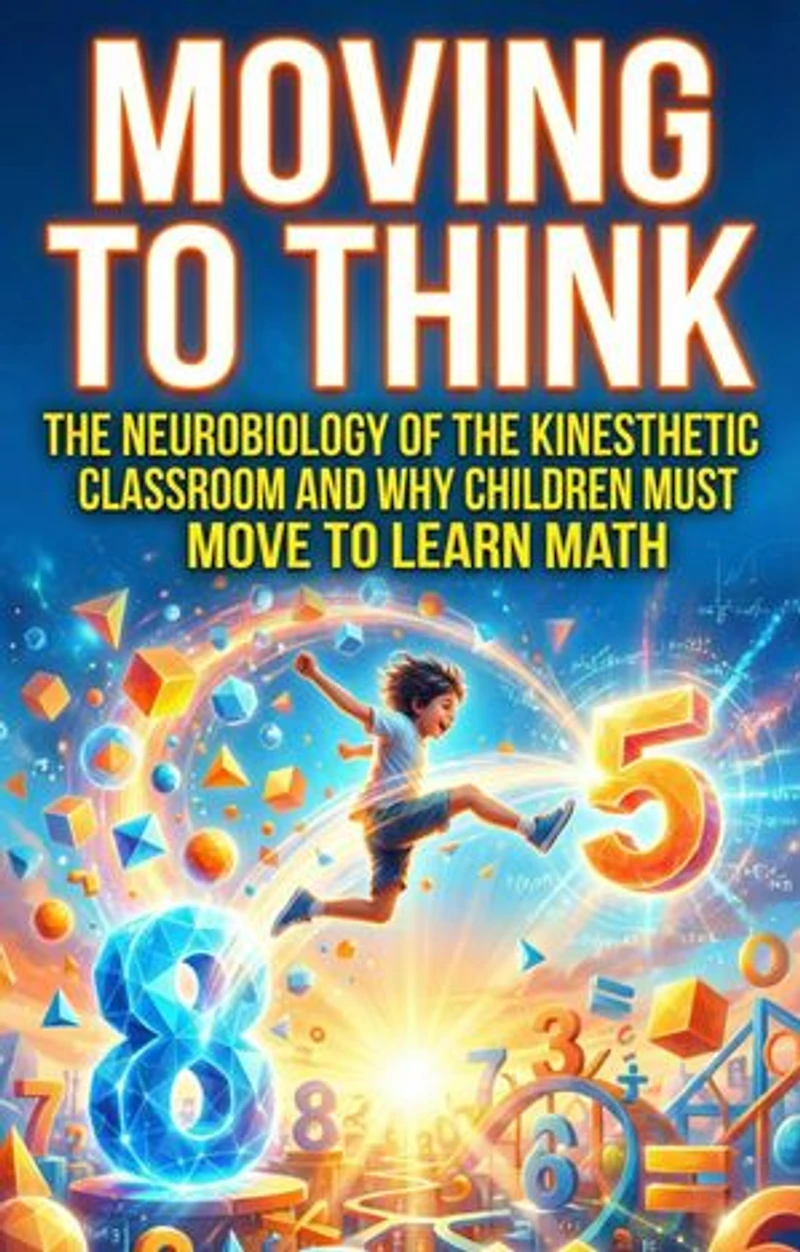
Moving to Think: The Neurobiology of the Kinesthetic Classroom and Why Children Must Move to Learn Math in Grande Prairie, AB
Current price: $7.99
Coles
Moving to Think: The Neurobiology of the Kinesthetic Classroom and Why Children Must Move to Learn Math in Grande Prairie, AB
Current price: $7.99
Loading Inventory...
Size: Kobo eBook
*Product information and pricing may vary - to confirm current pricing, availability, shipping, and return information please contact Coles. In the event of a pricing discrepancy, the retailer's price will apply.
Walk into almost any elementary school math class, and you will see the same scene: children sitting completely still at desks, staring at worksheets. We treat the brain as an isolated hard drive, believing that physical stillness is the absolute prerequisite for intellectual focus and abstract thought. This approach violently contradicts how the human brain actually develops. Cognitive neuroscience has proven that children do not process abstract concepts like geometry or fractions purely through visual or auditory input. They literally need to feel the spatial relationships in their muscles; movement is not a distraction, it is the primary engine of early learning. This book breaks down the science of embodied cognition in education. It reveals how physical movement, balance, and spatial navigation are deeply entangled with mathematical reasoning, and why forcing young children to sit still actively sabotages their ability to grasp complex, abstract logic. Transform your approach to early education. Teachers and parents will discover practical, dynamic strategies to integrate movement into academic lessons, creating kinesthetic classrooms where physical activity is weaponized to build deep, lasting neurological pathways for advanced problem-solving.
Walk into almost any elementary school math class, and you will see the same scene: children sitting completely still at desks, staring at worksheets. We treat the brain as an isolated hard drive, believing that physical stillness is the absolute prerequisite for intellectual focus and abstract thought. This approach violently contradicts how the human brain actually develops. Cognitive neuroscience has proven that children do not process abstract concepts like geometry or fractions purely through visual or auditory input. They literally need to feel the spatial relationships in their muscles; movement is not a distraction, it is the primary engine of early learning. This book breaks down the science of embodied cognition in education. It reveals how physical movement, balance, and spatial navigation are deeply entangled with mathematical reasoning, and why forcing young children to sit still actively sabotages their ability to grasp complex, abstract logic. Transform your approach to early education. Teachers and parents will discover practical, dynamic strategies to integrate movement into academic lessons, creating kinesthetic classrooms where physical activity is weaponized to build deep, lasting neurological pathways for advanced problem-solving.
You May Also Like















Find at Prairie Mall in Grande Prairie, AB
Visit at Prairie Mall in Grande Prairie, AB