


Gifting Made Simple
Give the Gift of ChoiceClick below to purchase a Prairie Mall eGift Card that can be used at participating retailers at Prairie Mall.Buy Gift CardHome
Machine Learning: A First Course For Engineers And Scientists
Coles
Loading Inventory...
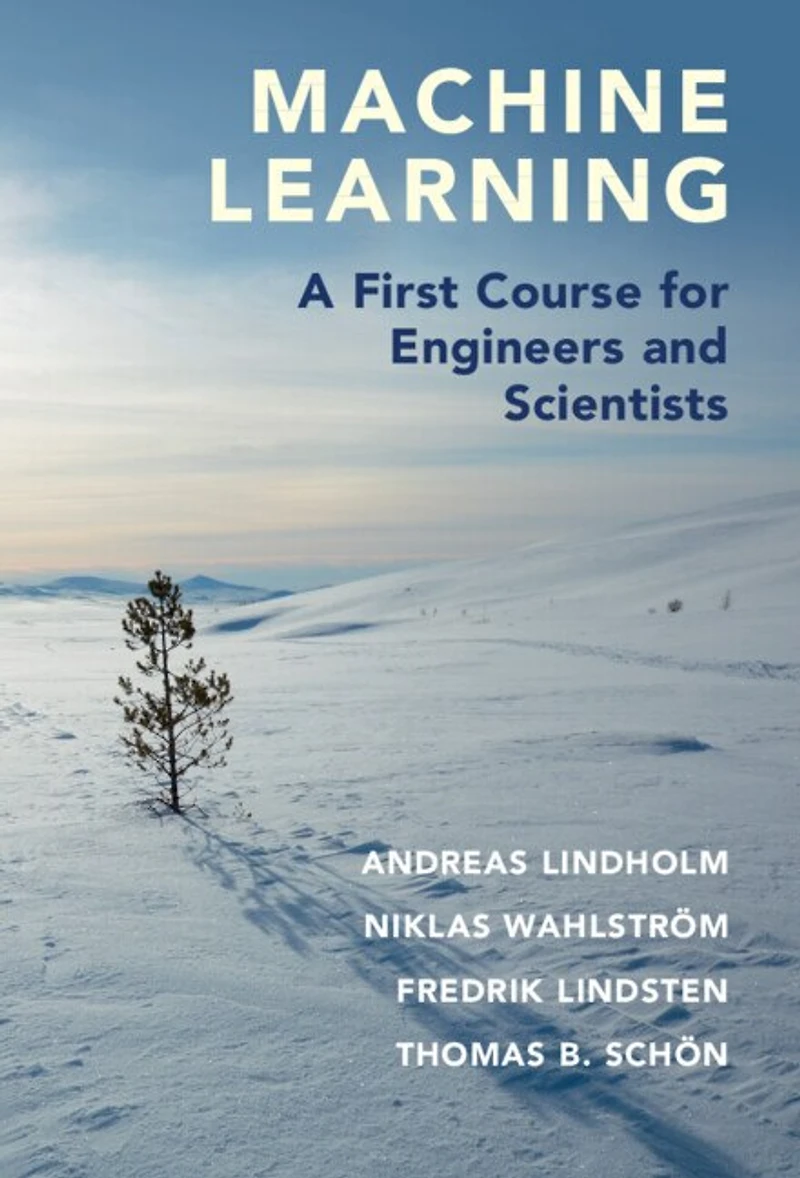
Machine Learning: A First Course For Engineers And Scientists in Grande Prairie, AB
Current price: $84.95
Coles
Machine Learning: A First Course For Engineers And Scientists in Grande Prairie, AB
Current price: $84.95
Loading Inventory...
Size: Hardcover
*Product information and pricing may vary - to confirm current pricing, availability, shipping, and return information please contact Coles. In the event of a pricing discrepancy, the retailer's price will apply.
This book introduces machine learning for readers with some background in basic linear algebra, statistics, probability, and programming. In a coherent statistical framework it covers a selection of supervised machine learning methods, from the most fundamental (k-NN, decision trees, linear and logistic regression) to more advanced methods (deep neural networks, support vector machines, Gaussian processes, random forests and boosting), plus commonly-used unsupervised methods (generative modeling, k-means, PCA, autoencoders and generative adversarial networks). Careful explanations and pseudo-code are presented for all methods. The authors maintain a focus on the fundamentals by drawing connections between methods and discussing general concepts such as loss functions, maximum likelihood, the bias-variance decomposition, ensemble averaging, kernels and the Bayesian approach along with generally useful tools such as regularization, cross validation, evaluation metrics and optimization methods. The final chapters offer practical advice for solving real-world supervised machine learning problems and on ethical aspects of modern machine learning.
This book introduces machine learning for readers with some background in basic linear algebra, statistics, probability, and programming. In a coherent statistical framework it covers a selection of supervised machine learning methods, from the most fundamental (k-NN, decision trees, linear and logistic regression) to more advanced methods (deep neural networks, support vector machines, Gaussian processes, random forests and boosting), plus commonly-used unsupervised methods (generative modeling, k-means, PCA, autoencoders and generative adversarial networks). Careful explanations and pseudo-code are presented for all methods. The authors maintain a focus on the fundamentals by drawing connections between methods and discussing general concepts such as loss functions, maximum likelihood, the bias-variance decomposition, ensemble averaging, kernels and the Bayesian approach along with generally useful tools such as regularization, cross validation, evaluation metrics and optimization methods. The final chapters offer practical advice for solving real-world supervised machine learning problems and on ethical aspects of modern machine learning.
You May Also Like










Find at Prairie Mall in Grande Prairie, AB
Visit at Prairie Mall in Grande Prairie, AB