


Gifting Made Simple
Give the Gift of ChoiceClick below to purchase a Prairie Mall eGift Card that can be used at participating retailers at Prairie Mall.Buy Gift CardHome
In-Band Full-Duplex Radios in 6g Networks: Implementation and Applications
Coles
Loading Inventory...
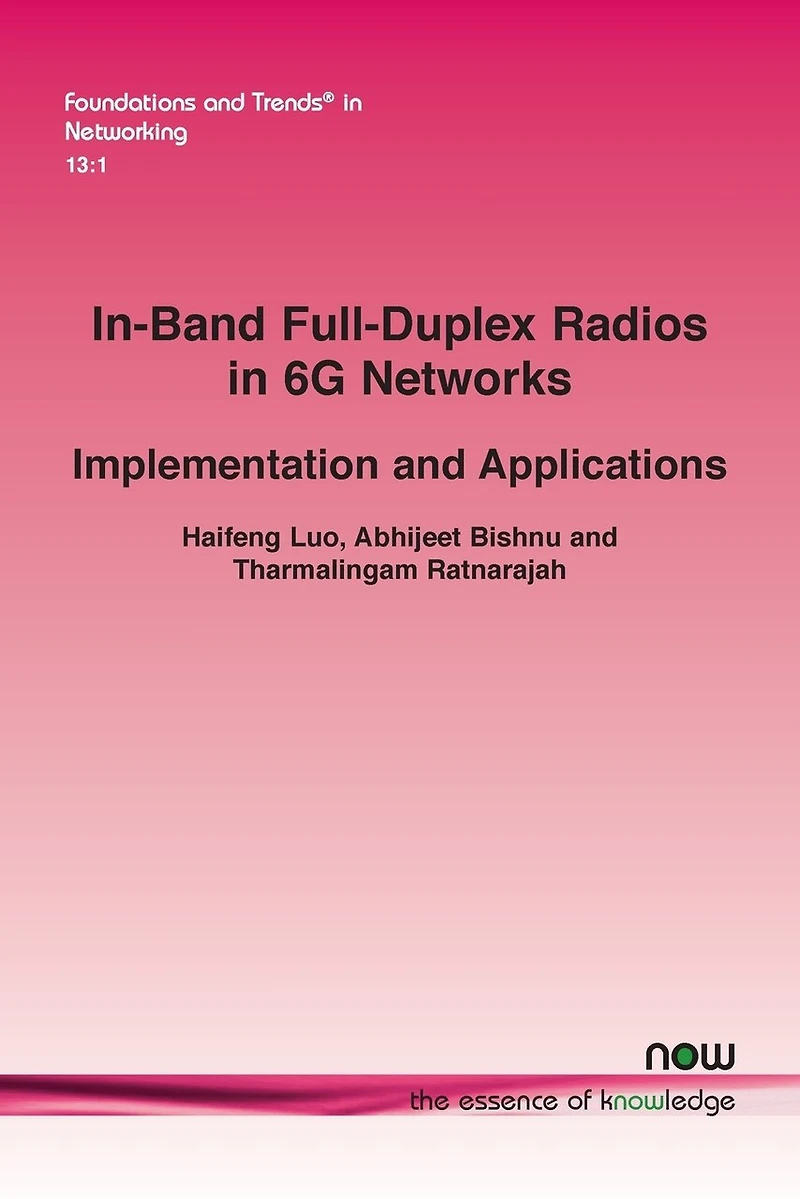
In-Band Full-Duplex Radios in 6g Networks: Implementation and Applications in Grande Prairie, AB
Current price: $104.00
Coles
In-Band Full-Duplex Radios in 6g Networks: Implementation and Applications in Grande Prairie, AB
Current price: $104.00
Loading Inventory...
Size: Paperback
*Product information and pricing may vary - to confirm current pricing, availability, shipping, and return information please contact Coles. In the event of a pricing discrepancy, the retailer's price will apply.
Sixth-generation (6G) wireless communication networks will transform connected things in 5G into connected intelligence. The networks can have human-like cognition capabilities by enabling many potential services, such as high-accuracy localization and tracking, augmented human sense, gesture and activity recognition, etc. For this purpose, many emerging applications in 6G have stringent requirements on transmission throughput and latency. With the explosion of devices in the connected intelligence world, spectrum utilization has to be enhanced to meet these stringent requirements. In-band full-duplex has been reported as a promising technique to enhance spectral efficiency and reduce end-to-end latency. However, simultaneous transmission and reception over the same frequency introduce additional interference compared to conventional half-duplex radios. The receiver is exposed to the transmitter of the same node operating in in-band full-duplex mode, causing self-interference. Due to the significant power difference between self-interference and the signal of interest, self-interference must be effectively suppressed to benefit from in-band full-duplex operation. In addition to self-interference, uplink users will interfere with downlink users within the range, known as co-channel interference. This interference could be significant in cellular networks, so it has to be appropriately processed to maximize the in-band full-duplex gain.
Sixth-generation (6G) wireless communication networks will transform connected things in 5G into connected intelligence. The networks can have human-like cognition capabilities by enabling many potential services, such as high-accuracy localization and tracking, augmented human sense, gesture and activity recognition, etc. For this purpose, many emerging applications in 6G have stringent requirements on transmission throughput and latency. With the explosion of devices in the connected intelligence world, spectrum utilization has to be enhanced to meet these stringent requirements. In-band full-duplex has been reported as a promising technique to enhance spectral efficiency and reduce end-to-end latency. However, simultaneous transmission and reception over the same frequency introduce additional interference compared to conventional half-duplex radios. The receiver is exposed to the transmitter of the same node operating in in-band full-duplex mode, causing self-interference. Due to the significant power difference between self-interference and the signal of interest, self-interference must be effectively suppressed to benefit from in-band full-duplex operation. In addition to self-interference, uplink users will interfere with downlink users within the range, known as co-channel interference. This interference could be significant in cellular networks, so it has to be appropriately processed to maximize the in-band full-duplex gain.
You May Also Like











Find at Prairie Mall in Grande Prairie, AB
Visit at Prairie Mall in Grande Prairie, AB