


Gifting Made Simple
Give the Gift of ChoiceClick below to purchase a Prairie Mall eGift Card that can be used at participating retailers at Prairie Mall.Buy Gift CardHome
Hyperstability of Control Systems
Coles
Loading Inventory...
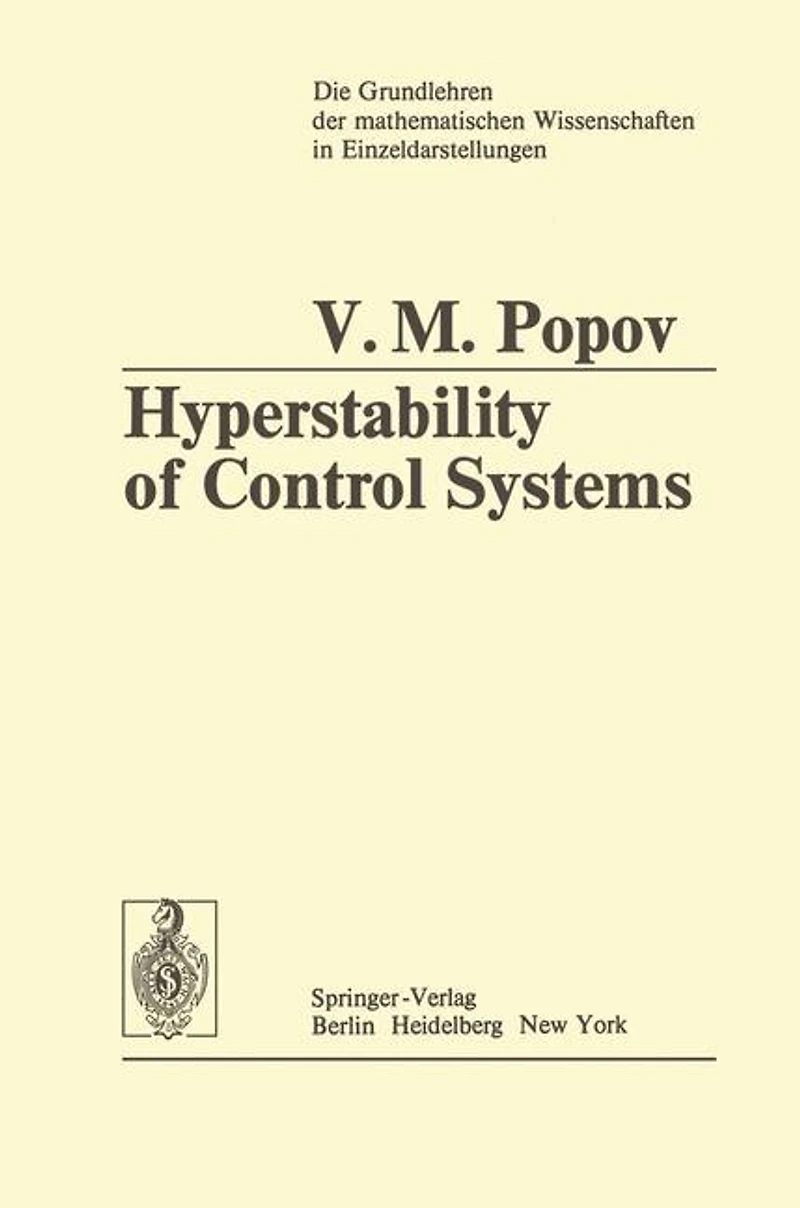
Hyperstability of Control Systems in Grande Prairie, AB
Current price: $33.95
Coles
Hyperstability of Control Systems in Grande Prairie, AB
Current price: $33.95
Loading Inventory...
Size: Paperback
*Product information and pricing may vary - to confirm current pricing, availability, shipping, and return information please contact Coles. In the event of a pricing discrepancy, the retailer's price will apply.
15 Liapunov's "second method" eliminates this drawback and leads to accurate conclusions regarding the stability of well-defined families of systems. This method made it natural to introduce the new notion of "absolute stability" whose origin can be traced to a work of . A. I. Lur'e and V. N. Post nikov [1]. The results of the many investigations effected to date in the field of absolute stability have been presented in a number of monographs, from which we mention (in chrono logical order) . A. I. Lur'e [1], . A. M. Letov [1], . A. Halanay Fig. 1. 2 [1], M . . A . . Aizerman and F. R. Gantmacher [1] and S. Lef schetz [1]. Without going into a detailed exposition of these results (see the final chapter of this book), we shall discuss here only the manner in which one defines the families of systems that are studied. These systems are characterized by the fact that in Relation (4) - which describes the non-linear block B2 (Fig. 1. 1) - the function cp is continuous, vanishes for v = 0 and satisfies the inequality cp( v)v > 0 for every v =/= o. (6) In other words, the graph of function cp is entirely contained in the quadrants I and III; it may have, for instance, a shape similar to that shown in Fig. 1. 2. The object of the study of absolute stability consists in finding a criterion which secures simultaneously the stability of all the systems characterized by Condition (6) .
15 Liapunov's "second method" eliminates this drawback and leads to accurate conclusions regarding the stability of well-defined families of systems. This method made it natural to introduce the new notion of "absolute stability" whose origin can be traced to a work of . A. I. Lur'e and V. N. Post nikov [1]. The results of the many investigations effected to date in the field of absolute stability have been presented in a number of monographs, from which we mention (in chrono logical order) . A. I. Lur'e [1], . A. M. Letov [1], . A. Halanay Fig. 1. 2 [1], M . . A . . Aizerman and F. R. Gantmacher [1] and S. Lef schetz [1]. Without going into a detailed exposition of these results (see the final chapter of this book), we shall discuss here only the manner in which one defines the families of systems that are studied. These systems are characterized by the fact that in Relation (4) - which describes the non-linear block B2 (Fig. 1. 1) - the function cp is continuous, vanishes for v = 0 and satisfies the inequality cp( v)v > 0 for every v =/= o. (6) In other words, the graph of function cp is entirely contained in the quadrants I and III; it may have, for instance, a shape similar to that shown in Fig. 1. 2. The object of the study of absolute stability consists in finding a criterion which secures simultaneously the stability of all the systems characterized by Condition (6) .
You May Also Like












Find at Prairie Mall in Grande Prairie, AB
Visit at Prairie Mall in Grande Prairie, AB