


Gifting Made Simple
Give the Gift of ChoiceClick below to purchase a Prairie Mall eGift Card that can be used at participating retailers at Prairie Mall.Buy Gift CardHome
Events And Semantic Architecture
Coles
Loading Inventory...
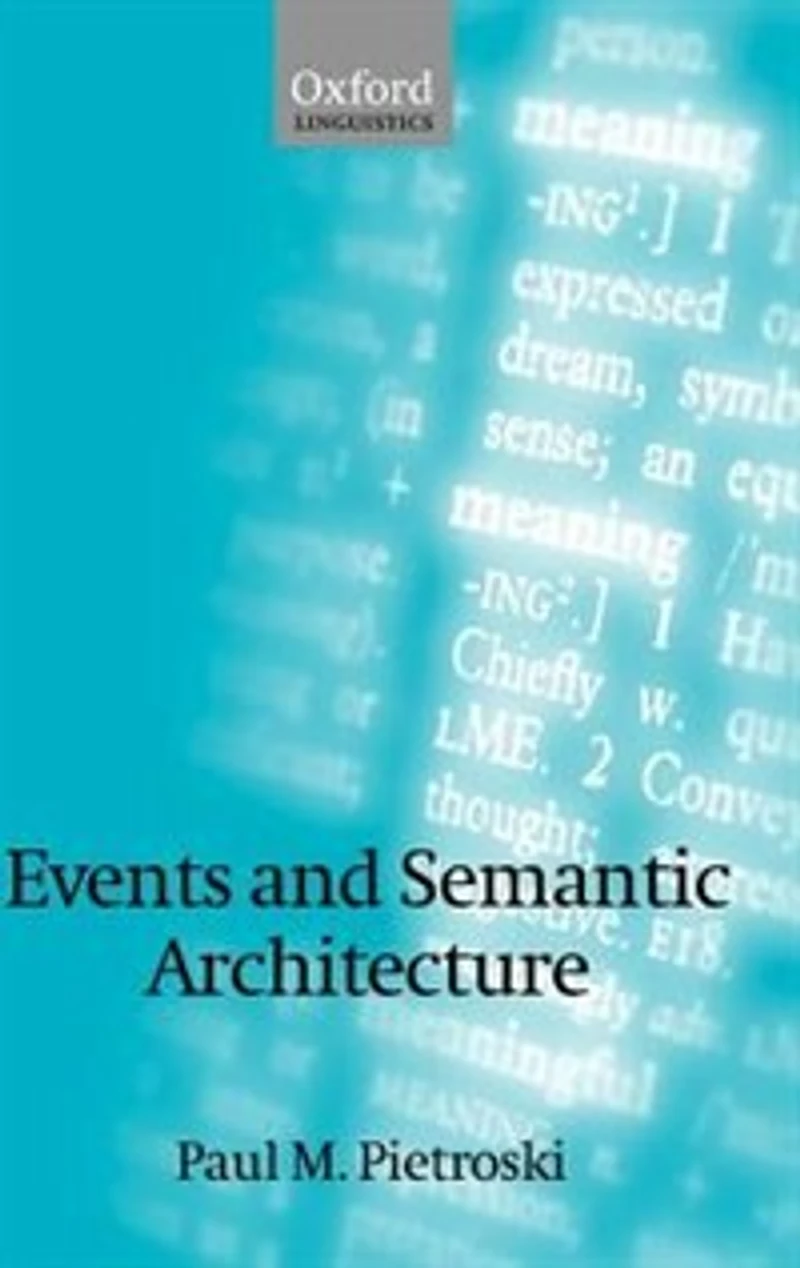
Events And Semantic Architecture in Grande Prairie, AB
Current price: $295.00
Coles
Events And Semantic Architecture in Grande Prairie, AB
Current price: $295.00
Loading Inventory...
Size: Hardcover
*Product information and pricing may vary - to confirm current pricing, availability, shipping, and return information please contact Coles. In the event of a pricing discrepancy, the retailer's price will apply.
This book explores how grammatical structure is related to meaning. The meaning of a phrase clearly depends on its constituent words and how they are combined. But how does structure contribute to meaning in natural language? Does combining adjectives with nouns (as in ''brown dog'') differ
semantically from combining verbs with adverbs (as in ''barked loudly'')? What is the significance of combining verbs with names and quantificational expressions (as in ''Fido chased every cat'')? In addressing such questions, Paul Pietroski develops a novel conception of linguistic meaning according to
which the semantic contribution of combining expressions is simple and uniform across constructions.
Drawing on work at the heart of contemporary debates in linguistics and philosophy, the author argues that Donald Davidson''s treatment of action sentences as event descriptions should be viewed as an instructive special case of a more general semantic theory. The unified theory covers a wide range
of examples, including sentences that involve quantification, plurality, descriptions of complex causal processes, and verbs that take sentential complements. Professor Pietroski also provides fresh ways of thinking about much-discussed semantic generalizations that seem to reflect innately
determined aspects of human languages.
Designed to be accessible to anyone with a basic knowledge of logic, Events and Semantic Architecture will interest advanced students of linguistics, philosophy, and cognitive science at graduate level and above.
This book explores how grammatical structure is related to meaning. The meaning of a phrase clearly depends on its constituent words and how they are combined. But how does structure contribute to meaning in natural language? Does combining adjectives with nouns (as in ''brown dog'') differ
semantically from combining verbs with adverbs (as in ''barked loudly'')? What is the significance of combining verbs with names and quantificational expressions (as in ''Fido chased every cat'')? In addressing such questions, Paul Pietroski develops a novel conception of linguistic meaning according to
which the semantic contribution of combining expressions is simple and uniform across constructions.
Drawing on work at the heart of contemporary debates in linguistics and philosophy, the author argues that Donald Davidson''s treatment of action sentences as event descriptions should be viewed as an instructive special case of a more general semantic theory. The unified theory covers a wide range
of examples, including sentences that involve quantification, plurality, descriptions of complex causal processes, and verbs that take sentential complements. Professor Pietroski also provides fresh ways of thinking about much-discussed semantic generalizations that seem to reflect innately
determined aspects of human languages.
Designed to be accessible to anyone with a basic knowledge of logic, Events and Semantic Architecture will interest advanced students of linguistics, philosophy, and cognitive science at graduate level and above.
You May Also Like








Find at Prairie Mall in Grande Prairie, AB
Visit at Prairie Mall in Grande Prairie, AB