


Gifting Made Simple
Give the Gift of ChoiceClick below to purchase a Prairie Mall eGift Card that can be used at participating retailers at Prairie Mall.Buy Gift CardHome
Elements of Queueing Theory: Palm Martingale Calculus and Stochastic Recurrences
Coles
Loading Inventory...
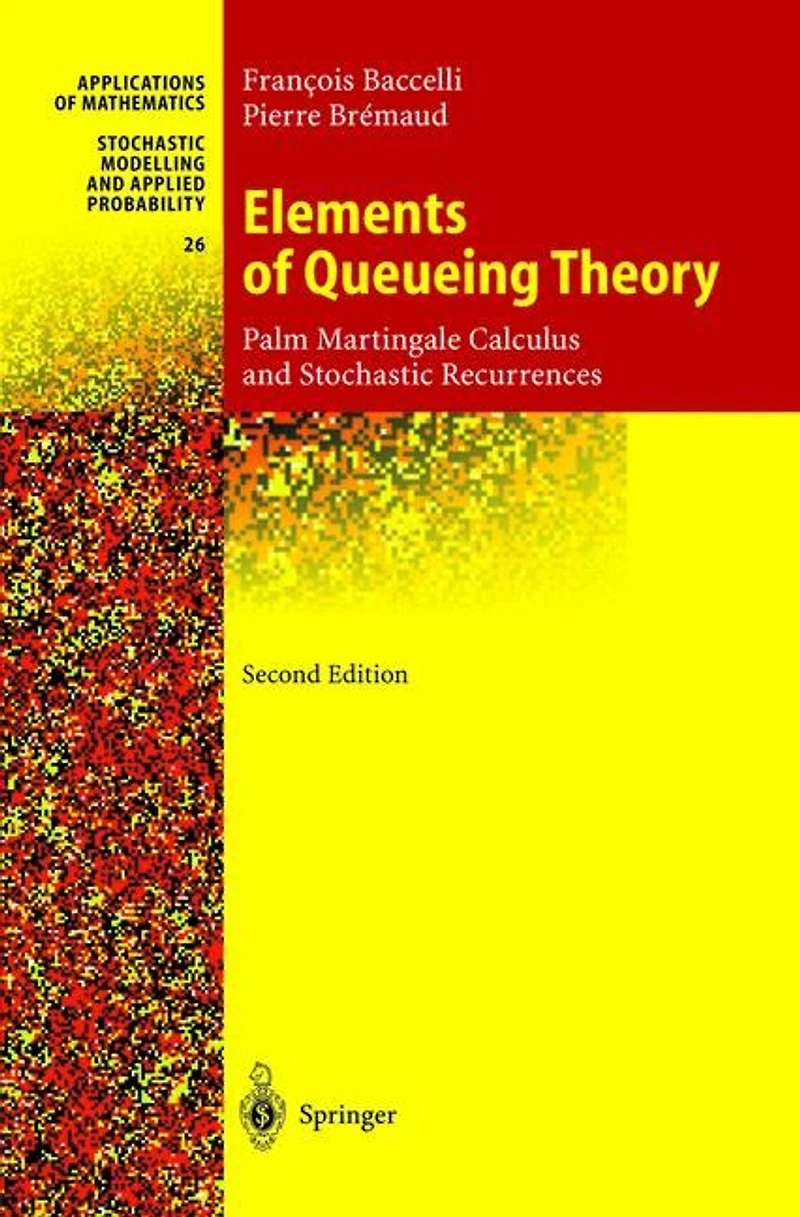
Elements of Queueing Theory: Palm Martingale Calculus and Stochastic Recurrences in Grande Prairie, AB
Current price: $160.95
Coles
Elements of Queueing Theory: Palm Martingale Calculus and Stochastic Recurrences in Grande Prairie, AB
Current price: $160.95
Loading Inventory...
Size: Hardcover
*Product information and pricing may vary - to confirm current pricing, availability, shipping, and return information please contact Coles. In the event of a pricing discrepancy, the retailer's price will apply.
Queueing theory is a fascinating subject in Applied Probability for two con tradictory reasons: it sometimes requires the most sophisticated tools of stochastic processes, and it often leads to simple and explicit answers. More over its interest has been steadily growing since the pioneering work of Erlang in 1917 on the blocking of telephone calls, to the more recent applications on the design of broadband communication networks and on the performance evaluation of computer architectures. All this led to a huge literature, articles and books, at various levels of mathematical rigor. Concerning the mathematical approach, most of the explicit results have been obtained when specific assumptions (Markov, re newal) are made. The aim of the present book is in no way to give a systematic account of the formulas of queueing theory and their applications, but rather to give a general framework in which these results are best understood and most easily derived. What knowledge of this vast literature is needed to read the book? As the title of the book suggests, we believe that it can be read without prior knowledge of queueing theory at all, although the unifying nature of the proposed framework will of course be more meaningful to readers who already studied the classical Markovian approach.
Queueing theory is a fascinating subject in Applied Probability for two con tradictory reasons: it sometimes requires the most sophisticated tools of stochastic processes, and it often leads to simple and explicit answers. More over its interest has been steadily growing since the pioneering work of Erlang in 1917 on the blocking of telephone calls, to the more recent applications on the design of broadband communication networks and on the performance evaluation of computer architectures. All this led to a huge literature, articles and books, at various levels of mathematical rigor. Concerning the mathematical approach, most of the explicit results have been obtained when specific assumptions (Markov, re newal) are made. The aim of the present book is in no way to give a systematic account of the formulas of queueing theory and their applications, but rather to give a general framework in which these results are best understood and most easily derived. What knowledge of this vast literature is needed to read the book? As the title of the book suggests, we believe that it can be read without prior knowledge of queueing theory at all, although the unifying nature of the proposed framework will of course be more meaningful to readers who already studied the classical Markovian approach.
You May Also Like








Find at Prairie Mall in Grande Prairie, AB
Visit at Prairie Mall in Grande Prairie, AB