


Gifting Made Simple
Give the Gift of ChoiceClick below to purchase a Prairie Mall eGift Card that can be used at participating retailers at Prairie Mall.Buy Gift CardHome
Computational Counterpoint Worlds: Mathematical Theory, Software, and Experiments
Coles
Loading Inventory...
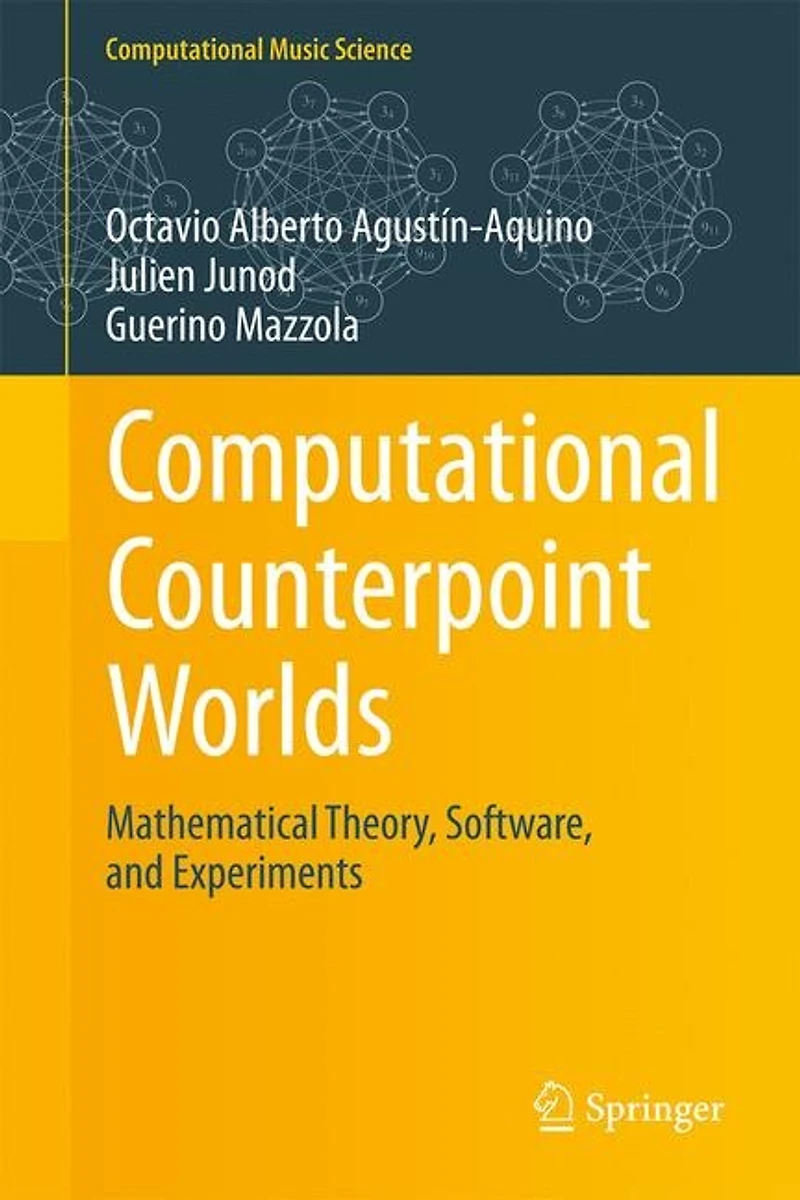
Computational Counterpoint Worlds: Mathematical Theory, Software, and Experiments in Grande Prairie, AB
Current price: $80.50
Coles
Computational Counterpoint Worlds: Mathematical Theory, Software, and Experiments in Grande Prairie, AB
Current price: $80.50
Loading Inventory...
Size: Hardcover
*Product information and pricing may vary - to confirm current pricing, availability, shipping, and return information please contact Coles. In the event of a pricing discrepancy, the retailer's price will apply.
The mathematical theory of counterpoint was originally aimed at simulating the composition rules described in Johann Joseph Fux's Gradus ad Parnassum. It soon became apparent that the algebraic apparatus used in this model could also serve to define entirely new systems of rules for composition, generated by new choices of consonances and dissonances, which in turn lead to new restrictions governing the succession of intervals. This is the first book bringing together recent developments and perspectives on mathematical counterpoint theory in detail. The authors include recent theoretical results on counterpoint worlds, the extension of counterpoint to microtonal pitch systems, the singular homology of counterpoint models, and the software implementation of contrapuntal models. The book is suitable for graduates and researchers. A good command of algebra is a prerequisite for understanding the construction of the model.
The mathematical theory of counterpoint was originally aimed at simulating the composition rules described in Johann Joseph Fux's Gradus ad Parnassum. It soon became apparent that the algebraic apparatus used in this model could also serve to define entirely new systems of rules for composition, generated by new choices of consonances and dissonances, which in turn lead to new restrictions governing the succession of intervals. This is the first book bringing together recent developments and perspectives on mathematical counterpoint theory in detail. The authors include recent theoretical results on counterpoint worlds, the extension of counterpoint to microtonal pitch systems, the singular homology of counterpoint models, and the software implementation of contrapuntal models. The book is suitable for graduates and researchers. A good command of algebra is a prerequisite for understanding the construction of the model.
You May Also Like














Find at Prairie Mall in Grande Prairie, AB
Visit at Prairie Mall in Grande Prairie, AB