


Gifting Made Simple
Give the Gift of ChoiceClick below to purchase a Prairie Mall eGift Card that can be used at participating retailers at Prairie Mall.Buy Gift CardHome
Complexity of Lattice Problems: A Cryptographic Perspective
Coles
Loading Inventory...
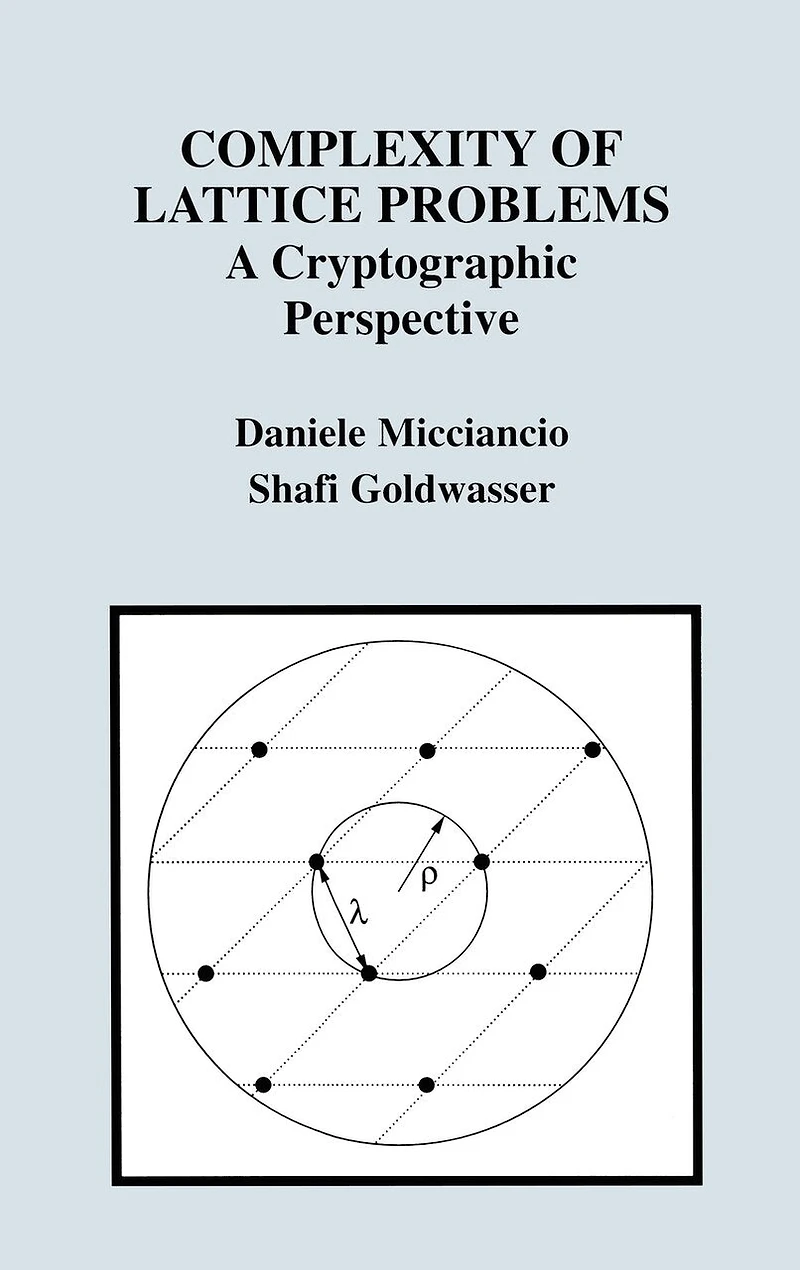
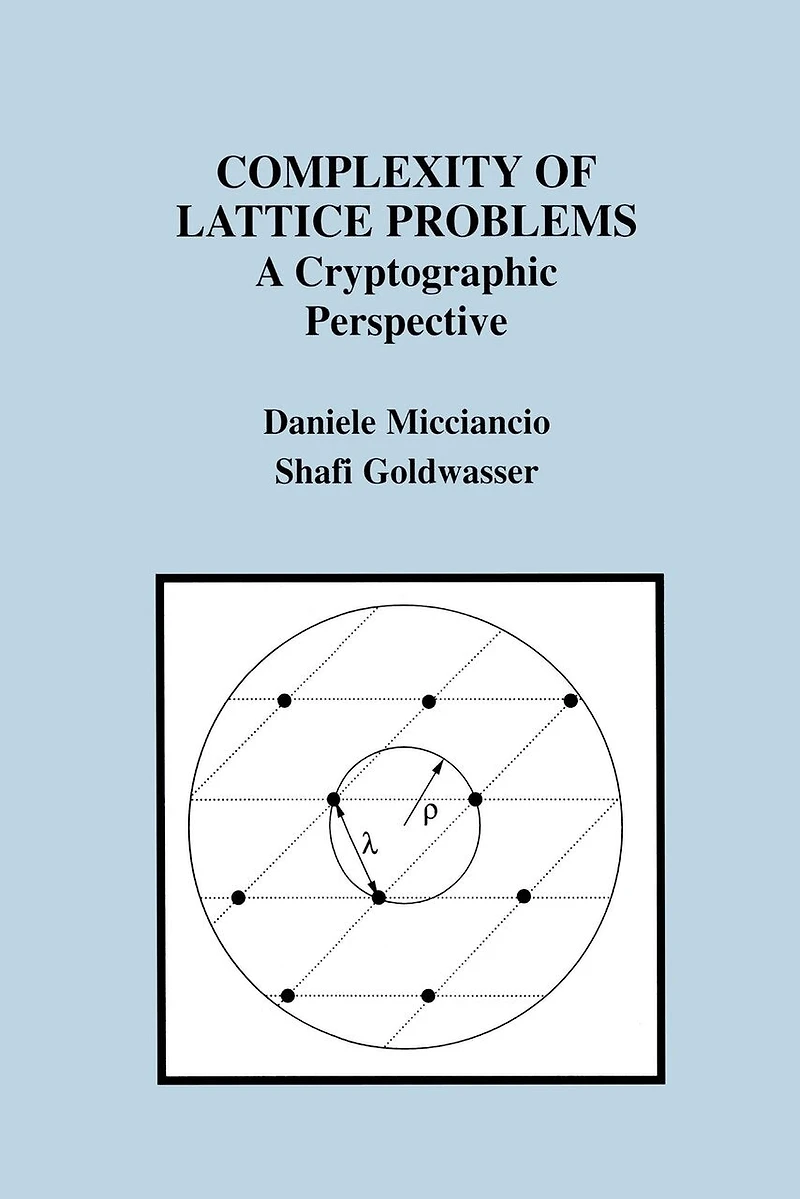
Complexity of Lattice Problems: A Cryptographic Perspective in Grande Prairie, AB
Current price: $350.20
Coles
Complexity of Lattice Problems: A Cryptographic Perspective in Grande Prairie, AB
Current price: $350.20
Loading Inventory...
Size: Hardcover
*Product information and pricing may vary - to confirm current pricing, availability, shipping, and return information please contact Coles. In the event of a pricing discrepancy, the retailer's price will apply.
Lattices are geometric objects that can be pictorially described as the set of intersection points of an infinite, regular n-dimensional grid. De spite their apparent simplicity, lattices hide a rich combinatorial struc ture, which has attracted the attention of great mathematicians over the last two centuries. Not surprisingly, lattices have found numerous ap plications in mathematics and computer science, ranging from number theory and Diophantine approximation, to combinatorial optimization and cryptography. The study of lattices, specifically from a computational point of view, was marked by two major breakthroughs: the development of the LLL lattice reduction algorithm by Lenstra, Lenstra and Lovasz in the early 80's, and Ajtai's discovery of a connection between the worst-case and average-case hardness of certain lattice problems in the late 90's. The LLL algorithm, despite the relatively poor quality of the solution it gives in the worst case, allowed to devise polynomial time solutions to many classical problems in computer science. These include, solving integer programs in a fixed number of variables, factoring polynomials over the rationals, breaking knapsack based cryptosystems, and finding solutions to many other Diophantine and cryptanalysis problems.
Lattices are geometric objects that can be pictorially described as the set of intersection points of an infinite, regular n-dimensional grid. De spite their apparent simplicity, lattices hide a rich combinatorial struc ture, which has attracted the attention of great mathematicians over the last two centuries. Not surprisingly, lattices have found numerous ap plications in mathematics and computer science, ranging from number theory and Diophantine approximation, to combinatorial optimization and cryptography. The study of lattices, specifically from a computational point of view, was marked by two major breakthroughs: the development of the LLL lattice reduction algorithm by Lenstra, Lenstra and Lovasz in the early 80's, and Ajtai's discovery of a connection between the worst-case and average-case hardness of certain lattice problems in the late 90's. The LLL algorithm, despite the relatively poor quality of the solution it gives in the worst case, allowed to devise polynomial time solutions to many classical problems in computer science. These include, solving integer programs in a fixed number of variables, factoring polynomials over the rationals, breaking knapsack based cryptosystems, and finding solutions to many other Diophantine and cryptanalysis problems.
You May Also Like















Find at Prairie Mall in Grande Prairie, AB
Visit at Prairie Mall in Grande Prairie, AB