


Gifting Made Simple
Give the Gift of ChoiceClick below to purchase a Prairie Mall eGift Card that can be used at participating retailers at Prairie Mall.Buy Gift CardHome
Codes for Adversaries: Between Worst-Case and Average-Case Jamming
Coles
Loading Inventory...
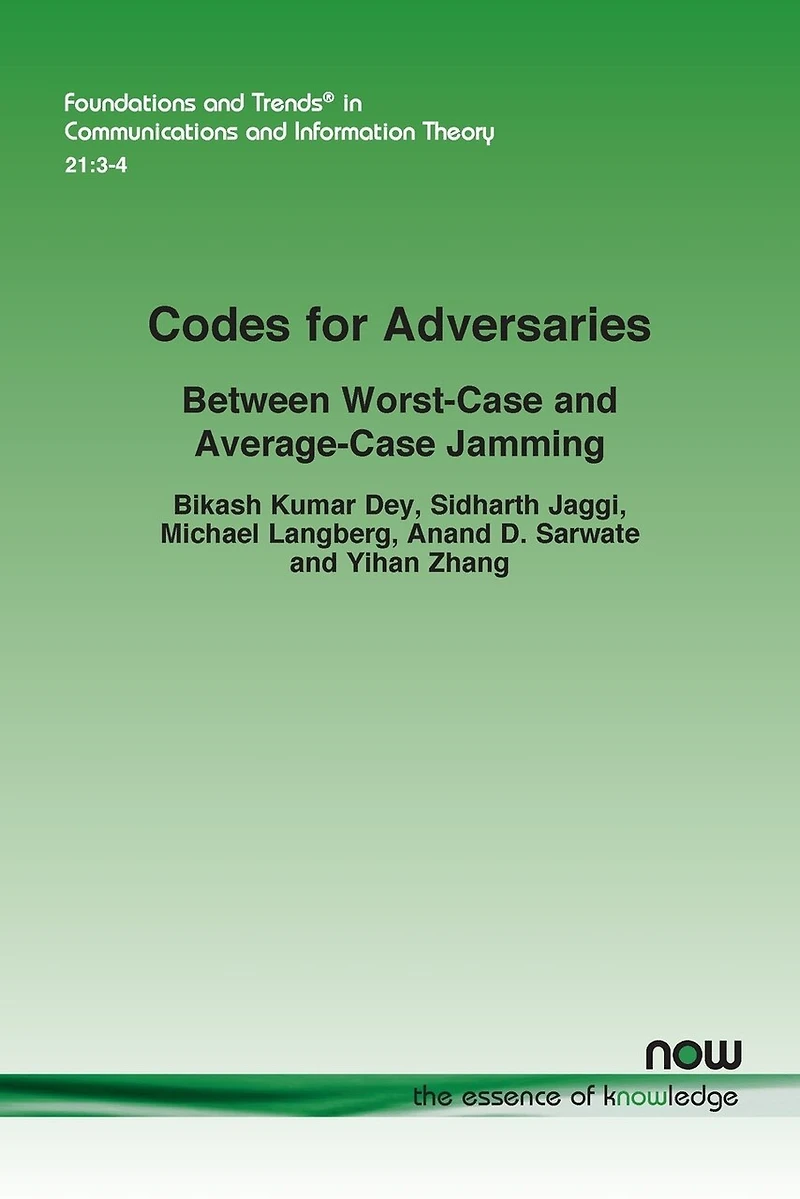
Codes for Adversaries: Between Worst-Case and Average-Case Jamming in Grande Prairie, AB
Current price: $128.95
Coles
Codes for Adversaries: Between Worst-Case and Average-Case Jamming in Grande Prairie, AB
Current price: $128.95
Loading Inventory...
Size: Paperback
*Product information and pricing may vary - to confirm current pricing, availability, shipping, and return information please contact Coles. In the event of a pricing discrepancy, the retailer's price will apply.
Over the last 70 years, information theory and coding have enabled communication technologies that have had an astounding impact on our lives. This is possible due to the match between encoding/decoding strategies and corresponding channel models. Traditional studies of channels have taken one of two extremes: Shannon-theoretic models are inherently average-case in which channel noise is governed by a memoryless stochastic process, whereas coding-theoretic (referred to as "Hamming") models take a worst-case, adversarial, view of the noise. However, for several existing and emerging communication systems, the Shannon/average-case view may be too optimistic, whereas the Hamming/worst-case view may be too pessimistic. This monograph takes up the challenge of studying adversarial channel models that lie between the Shannon and Hamming extremes.
Over the last 70 years, information theory and coding have enabled communication technologies that have had an astounding impact on our lives. This is possible due to the match between encoding/decoding strategies and corresponding channel models. Traditional studies of channels have taken one of two extremes: Shannon-theoretic models are inherently average-case in which channel noise is governed by a memoryless stochastic process, whereas coding-theoretic (referred to as "Hamming") models take a worst-case, adversarial, view of the noise. However, for several existing and emerging communication systems, the Shannon/average-case view may be too optimistic, whereas the Hamming/worst-case view may be too pessimistic. This monograph takes up the challenge of studying adversarial channel models that lie between the Shannon and Hamming extremes.
You May Also Like











Find at Prairie Mall in Grande Prairie, AB
Visit at Prairie Mall in Grande Prairie, AB