


Gifting Made Simple
Give the Gift of ChoiceClick below to purchase a Prairie Mall eGift Card that can be used at participating retailers at Prairie Mall.Buy Gift CardHome
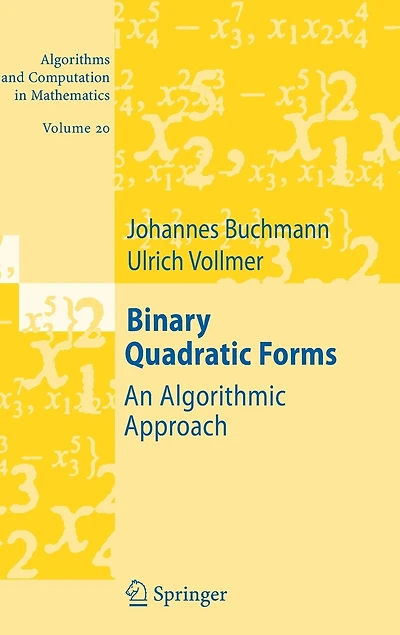
Binary Quadratic Forms: Classical Theory and Modern Computations
Coles
Loading Inventory...
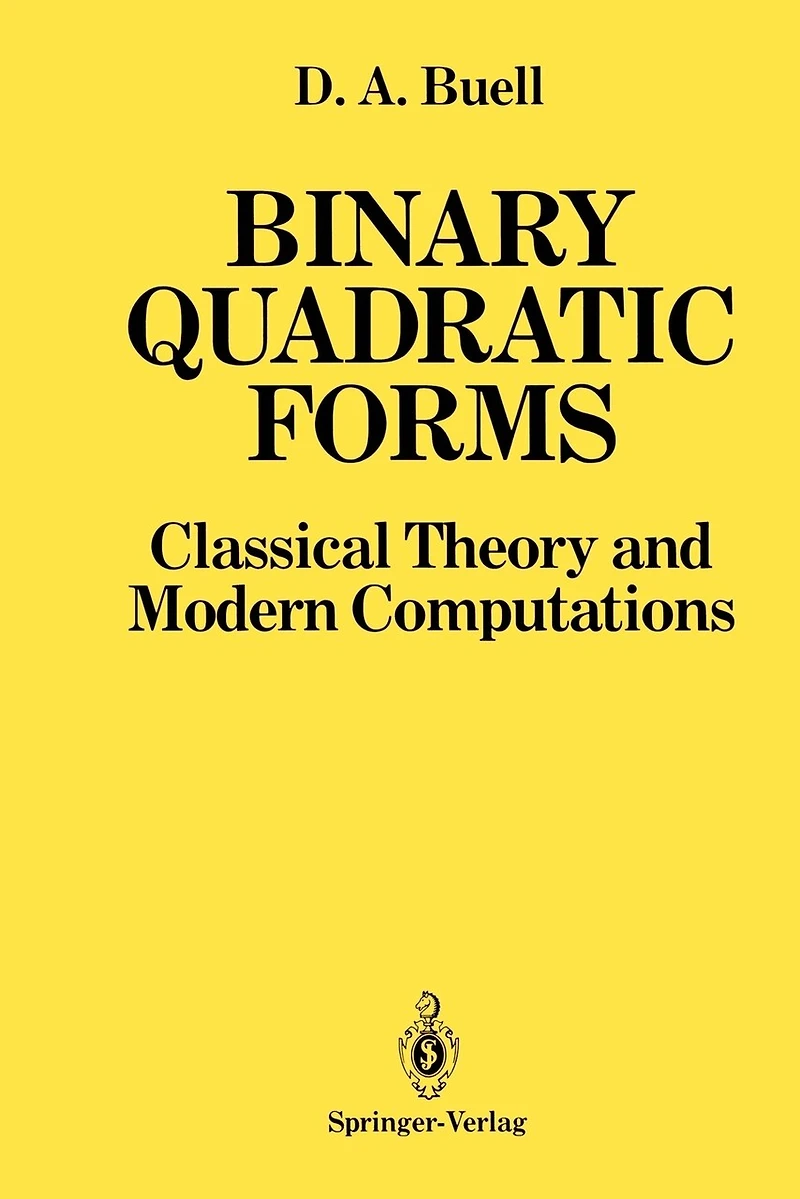
Binary Quadratic Forms: Classical Theory and Modern Computations in Grande Prairie, AB
Current price: $194.06
Coles
Binary Quadratic Forms: Classical Theory and Modern Computations in Grande Prairie, AB
Current price: $194.06
Loading Inventory...
Size: Paperback
*Product information and pricing may vary - to confirm current pricing, availability, shipping, and return information please contact Coles. In the event of a pricing discrepancy, the retailer's price will apply.
The first coherent exposition of the theory of binary quadratic forms was given by Gauss in the Disqnisitiones Arithmeticae. During the nine teenth century, as the theory of ideals and the rudiments of algebraic number theory were developed, it became clear that this theory of bi nary quadratic forms, so elementary and computationally explicit, was indeed just a special case of a much more elega,nt and abstract theory which, unfortunately, is not computationally explicit. In recent years the original theory has been laid aside. Gauss's proofs, which involved brute force computations that can be done in what is essentially a two dimensional vector space, have been dropped in favor of n-dimensional arguments which prove the general theorems of algebraic number the ory. In consequence, this elegant, yet pleasantly simple, theory has been neglected even as some of its results have become extremely useful in certain computations. I find this neglect unfortunate, because binary quadraticforms have two distinct attractions. First, the subject involves explicit computa tion and many of the computer programs can be quite simple. The use of computers in experimenting with examples is both meaningful and enjoyable; one can actually discover interesting results by com puting examples, noticing patterns in the "data," and then proving that the patterns result from the conclusion of some provable theorem.
The first coherent exposition of the theory of binary quadratic forms was given by Gauss in the Disqnisitiones Arithmeticae. During the nine teenth century, as the theory of ideals and the rudiments of algebraic number theory were developed, it became clear that this theory of bi nary quadratic forms, so elementary and computationally explicit, was indeed just a special case of a much more elega,nt and abstract theory which, unfortunately, is not computationally explicit. In recent years the original theory has been laid aside. Gauss's proofs, which involved brute force computations that can be done in what is essentially a two dimensional vector space, have been dropped in favor of n-dimensional arguments which prove the general theorems of algebraic number the ory. In consequence, this elegant, yet pleasantly simple, theory has been neglected even as some of its results have become extremely useful in certain computations. I find this neglect unfortunate, because binary quadraticforms have two distinct attractions. First, the subject involves explicit computa tion and many of the computer programs can be quite simple. The use of computers in experimenting with examples is both meaningful and enjoyable; one can actually discover interesting results by com puting examples, noticing patterns in the "data," and then proving that the patterns result from the conclusion of some provable theorem.
You May Also Like








Find at Prairie Mall in Grande Prairie, AB
Visit at Prairie Mall in Grande Prairie, AB