


Gifting Made Simple
Give the Gift of ChoiceClick below to purchase a Prairie Mall eGift Card that can be used at participating retailers at Prairie Mall.Buy Gift CardHome
Analytic Information Theory: From Compression to Learning
Coles
Loading Inventory...
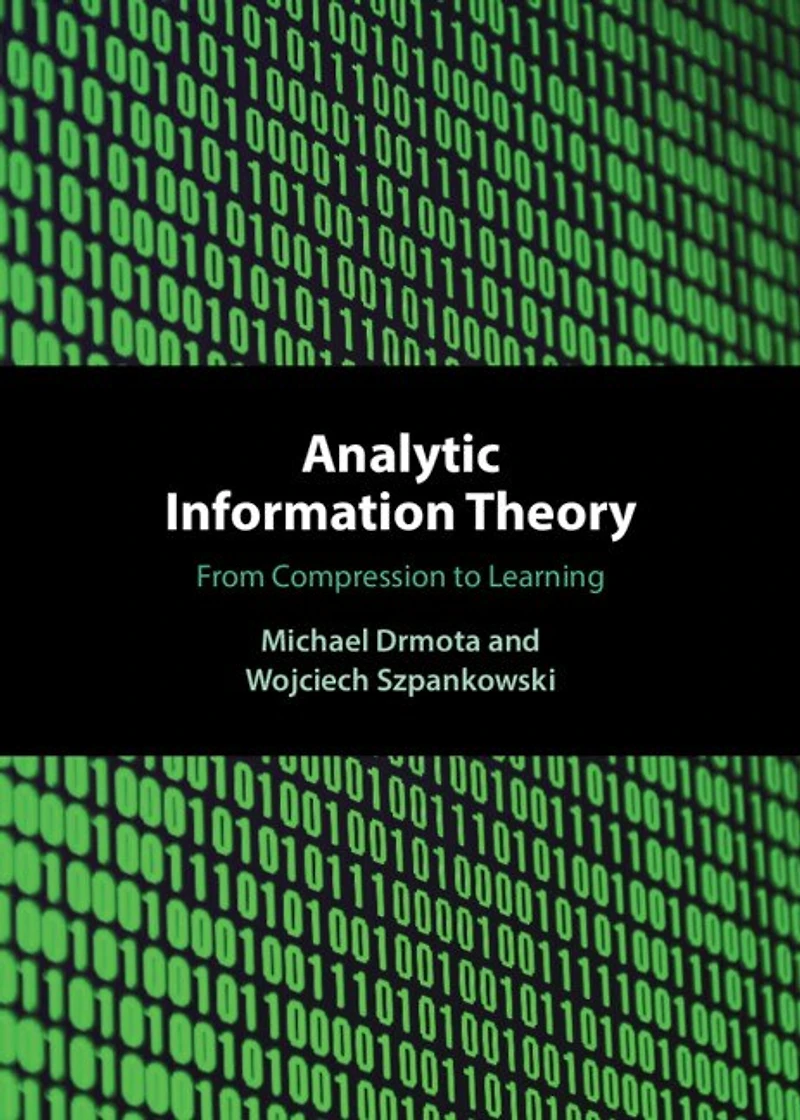
Analytic Information Theory: From Compression to Learning in Grande Prairie, AB
Current price: $186.95
Coles
Analytic Information Theory: From Compression to Learning in Grande Prairie, AB
Current price: $186.95
Loading Inventory...
Size: Hardcover
*Product information and pricing may vary - to confirm current pricing, availability, shipping, and return information please contact Coles. In the event of a pricing discrepancy, the retailer's price will apply.
Through information theory, problems of communication and compression can be precisely modeled, formulated, and analyzed, and this information can be transformed by means of algorithms. Also, learning can be viewed as compression with side information. Aimed at students and researchers, this book addresses data compression and redundancy within existing methods and central topics in theoretical data compression, demonstrating how to use tools from analytic combinatorics to discover and analyze precise behavior of source codes. It shows that to present better learnable or extractable information in its shortest description, one must understand what the information is, and then algorithmically extract it in its most compact form via an efficient compression algorithm. Part I covers fixed-to-variable codes such as Shannon and Huffman codes, variable-to-fixed codes such as Tunstall and Khodak codes, and variable-to-variable Khodak codes for known sources. Part II discusses universal source coding for memoryless, Markov, and renewal sources.
Through information theory, problems of communication and compression can be precisely modeled, formulated, and analyzed, and this information can be transformed by means of algorithms. Also, learning can be viewed as compression with side information. Aimed at students and researchers, this book addresses data compression and redundancy within existing methods and central topics in theoretical data compression, demonstrating how to use tools from analytic combinatorics to discover and analyze precise behavior of source codes. It shows that to present better learnable or extractable information in its shortest description, one must understand what the information is, and then algorithmically extract it in its most compact form via an efficient compression algorithm. Part I covers fixed-to-variable codes such as Shannon and Huffman codes, variable-to-fixed codes such as Tunstall and Khodak codes, and variable-to-variable Khodak codes for known sources. Part II discusses universal source coding for memoryless, Markov, and renewal sources.
You May Also Like









Find at Prairie Mall in Grande Prairie, AB
Visit at Prairie Mall in Grande Prairie, AB