


Gifting Made Simple
Give the Gift of ChoiceClick below to purchase a Prairie Mall eGift Card that can be used at participating retailers at Prairie Mall.Buy Gift CardHome
Algorithmic and Combinatorial Algebra
Coles
Loading Inventory...
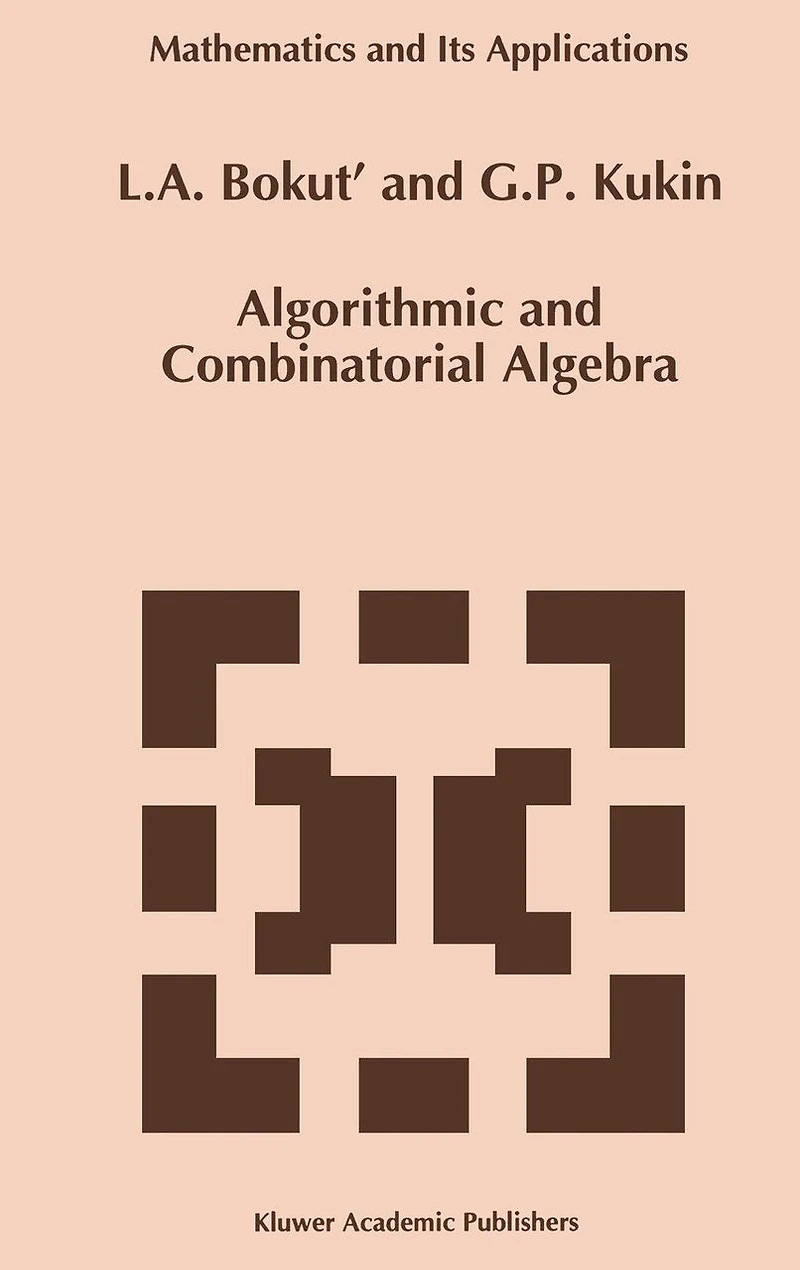
Algorithmic and Combinatorial Algebra in Grande Prairie, AB
Current price: $142.95
Coles
Algorithmic and Combinatorial Algebra in Grande Prairie, AB
Current price: $142.95
Loading Inventory...
Size: Hardcover
*Product information and pricing may vary - to confirm current pricing, availability, shipping, and return information please contact Coles. In the event of a pricing discrepancy, the retailer's price will apply.
Even three decades ago, the words 'combinatorial algebra' contrasting, for in stance, the words 'combinatorial topology,' were not a common designation for some branch of mathematics. The collocation 'combinatorial group theory' seems to ap pear first as the title of the book by A. Karras, W. Magnus, and D. Solitar [182] and, later on, it served as the title of the book by R. C. Lyndon and P. Schupp [247]. Nowadays, specialists do not question the existence of 'combinatorial algebra' as a special algebraic activity. The activity is distinguished not only by its objects of research (that are effectively given to some extent) but also by its methods (ef fective to some extent). To be more exact, we could approximately define the term 'combinatorial algebra' for the purposes of this book, as follows: So we call a part of algebra dealing with groups, semi groups , associative algebras, Lie algebras, and other algebraic systems which are given by generators and defining relations {in the first and particular place, free groups, semigroups, algebras, etc. )j a part in which we study universal constructions, viz. free products, lINN-extensions, etc. j and, finally, a part where specific methods such as the Composition Method (in other words, the Diamond Lemma, see [49]) are applied. Surely, the above explanation is far from covering the full scope of the term (compare the prefaces to the books mentioned above).
Even three decades ago, the words 'combinatorial algebra' contrasting, for in stance, the words 'combinatorial topology,' were not a common designation for some branch of mathematics. The collocation 'combinatorial group theory' seems to ap pear first as the title of the book by A. Karras, W. Magnus, and D. Solitar [182] and, later on, it served as the title of the book by R. C. Lyndon and P. Schupp [247]. Nowadays, specialists do not question the existence of 'combinatorial algebra' as a special algebraic activity. The activity is distinguished not only by its objects of research (that are effectively given to some extent) but also by its methods (ef fective to some extent). To be more exact, we could approximately define the term 'combinatorial algebra' for the purposes of this book, as follows: So we call a part of algebra dealing with groups, semi groups , associative algebras, Lie algebras, and other algebraic systems which are given by generators and defining relations {in the first and particular place, free groups, semigroups, algebras, etc. )j a part in which we study universal constructions, viz. free products, lINN-extensions, etc. j and, finally, a part where specific methods such as the Composition Method (in other words, the Diamond Lemma, see [49]) are applied. Surely, the above explanation is far from covering the full scope of the term (compare the prefaces to the books mentioned above).
You May Also Like








Find at Prairie Mall in Grande Prairie, AB
Visit at Prairie Mall in Grande Prairie, AB